

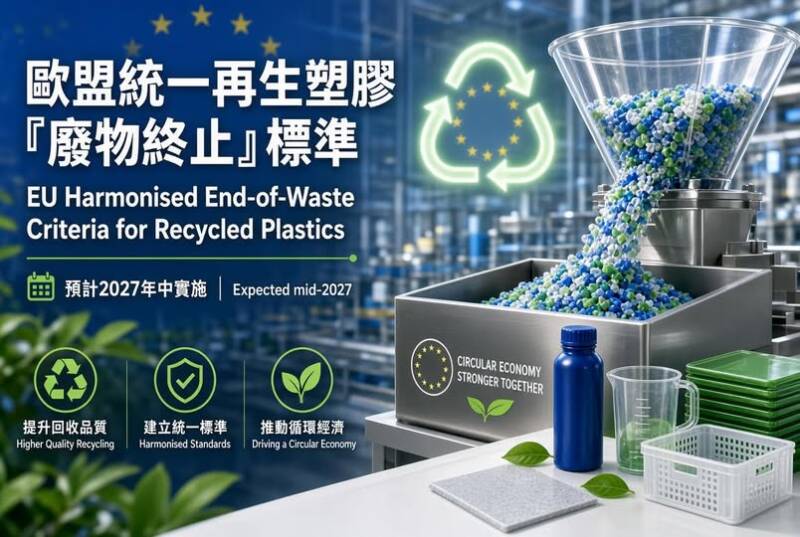
On 3 November, EU member states voted at a European Commission Technical Adaptation Committee meeting to approve EU-wide end-of-waste criteria for recycled plastics. The industry has called it a long-awaited step for Europe's recycled plastics market.
What does "end-of-waste" mean?
Under EU law, plastic that has been collected and reprocessed can still be legally classed as "waste", which brings waste-shipment rules, permits and paperwork. End-of-waste criteria define exactly when recycled plastic stops being waste and can be traded freely across the EU as a product and secondary raw material.
Until now, each member state has set its own rules or decided case by case, creating a regulatory patchwork. The European Waste Management Association (FEAD) estimates that the lack of common criteria costs EU plastics recyclers about €120 million a year.
Key requirements
- Less than 1.9% foreign (non-plastic) material by moisture-free weight
- Producers must run a certified quality-management system
- A digital statement of conformity for every consignment
- Criteria cover input materials, recycling processes, product quality and documentation
- Imports from outside the EU must meet equivalent requirements, to keep a level playing field
- Covers mechanical and solvent-based (physical) recycling; chemical recycling such as pyrolysis and depolymerisation is excluded for now, though the Commission may review this later
Timeline
- 2022: technical work begins
- Late 2025 to early 2026: the Commission proposes the regulation
- 3 November 2026: member states vote in favour
- Next: formal adoption by the Commission and publication in the Official Journal; entry into force usually 20 days later
- Expected to apply about six months after entry into force, around mid-2027
Industry reaction
Recycling Europe called the vote "a long-awaited step towards a more integrated and competitive European market for recycled plastics," while noting that progress has been slow. Mathilde Taveau of Plastics Recyclers Europe said the criteria will "reduce the administrative burden resulting from different national and case-by-case approaches" and are "crucial for removing existing bottlenecks."
The industry also warns that regulation alone is not enough. European recyclers face high energy and operating costs and competition from low-cost imports of virgin and recycled plastics, and Zero Waste Europe points to the cost advantage of virgin plastics as a key challenge. Many hope the upcoming Circular Economy Act will do more to boost demand for recycled materials.
What it means for the plastics raw materials market
Once in force, compliant recycled plastics can move across borders like any other raw material, with far less red tape. For suppliers, including those outside the EU, certified quality management and digital documentation will become the entry ticket to the European market.
歐盟再生塑膠即將「脫離廢物身份」:成員國通過統一「廢物終止」標準
歐盟成員國於 11 月 3 日在歐盟委員會的技術適應委員會會議上,表決通過全歐統一的再生塑膠「廢物終止」(end-of-waste)標準。業界形容這是歐洲再生塑膠市場「期待已久的一步」。
什麼是「廢物終止」?
在歐盟法例下,塑膠廢料即使已經回收加工,在法律上仍可能被視為「廢物」,要受廢物運輸、許可等規管。「廢物終止」標準就是訂明再生塑膠在什麼條件下不再是廢物,可以作為「產品」和二次原料在歐盟內自由買賣。
過去各成員國自訂標準或逐個審批,形成一塊塊「法規拼圖」。歐洲廢物管理協會(FEAD)估計,缺乏統一標準每年令歐盟塑膠回收商損失約 1.2 億歐元。
主要要求
- 再生料的雜質(非塑膠物料)含量須低於 1.9%(以乾重計)
- 生產商須設有經認證的品質管理系統
- 每批貨須簽發數碼化的「合規聲明」
- 標準涵蓋原料、回收工序、產品質素及文件合規
- 從歐盟以外進口的再生塑膠須符合同等要求,確保公平競爭
- 適用於機械回收及溶劑型(物理)回收;熱解、解聚等化學回收暫不包括在內,委員會日後或會重新檢視
時間表
- 2022 年:技術工作開展
- 2025 年底至 2026 年初:歐盟委員會提出規例草案
- 2026 年 11 月 3 日:成員國表決通過
- 下一步:委員會正式採納並刊登歐盟公報,一般於刊登後 20 日生效
- 預計生效後約六個月(約 2027 年中)開始實施
業界反應
Recycling Europe 形容此舉是「朝更統一、更具競爭力的歐洲再生塑膠市場邁出的期待已久的一步」,但亦指進展緩慢。歐洲塑膠回收商協會(Plastics Recyclers Europe)的 Mathilde Taveau 認為,標準將「減少各國各自為政、逐個審批帶來的行政負擔」,並「對消除現有瓶頸至關重要」。
不過業界亦提醒,單靠法規不足以解決問題。歐洲回收商正面對高能源及營運成本,以及低價進口原生和再生塑膠的競爭。Zero Waste Europe 則指出,原生塑膠的成本優勢仍是主要挑戰。業界期望即將推出的《循環經濟法》(Circular Economy Act)能進一步刺激再生料需求。
對塑膠原料業的意義
統一標準實施後,符合要求的再生塑膠可以像一般原料一樣跨國買賣,減少行政程序。對供應商而言,品質管理及數碼文件將成為進入歐洲市場的基本條件,包括來自歐盟以外的供應商。
Add comment
Comments